Tuesday, July 7, 2015

Constructing Potato Boxes


Or... How I Built A Potato Planter Box

Potatoes are really fun to grow.  It is always so amazing to me that from a few small "seed potatoes" a whole basket full will develop.  All summer long the potato plants grow above ground and the new tubers develop, hidden, underground.  I wanted to plant potatoes because, if for no other reason, I look forward to harvesting them.  It is like digging for treasure!  Also, of course, freshly dug potatoes are so delicious!!!

Potatoes need a soil that has good drainage so that the tubers don't rot.  They also need a deep soil so that there is plenty of room for the tubers to develop. As I have stated previously, the soil in my yard is mostly clay and rocks, a combination which is not great for growing potatoes.  So, some sort of "raised-bed potato-planter-box" was in order!

Since I had decided to go with wooden framed raised garden beds, I wanted a potato planter box that would look similar to the wooden frames that I was using for the rest of the garden.  I know that as the season progresses I will have to "hill up" the potato plants....add more soil to encourage more potatoes to form underground.  I envisioned the potato planter box would start out as a shallow frame, and then I would add on another shallow frame on top of the first one and perhaps another shallow frame on top of the second one, etc.  The frames had to fit one on top of the other securely so they wouldn't topple or tip over.  I also remember that in the Fall when I dig the potatoes up, I'm going to have to take this potato box apart.  So, the finished box layers needed to be sturdy, fit together well, yet be lightweight, and easy to take apart.    

I searched on the internet for ideas.  In the end, I think I combined several different ideas for my potato planter box.

It took me a while to figure out the materials that I would use.  I settled on unfinished 6"X6' cedar fencing.  I also used 4" pieces of 2"x3" pine to secure and support the corners.


I cut the cedar fencing in 3' lengths.
I also cut the 2"X3" lumber into 4" lengths.

I drilled pilot holes.


And then fastened the corners together with screws.

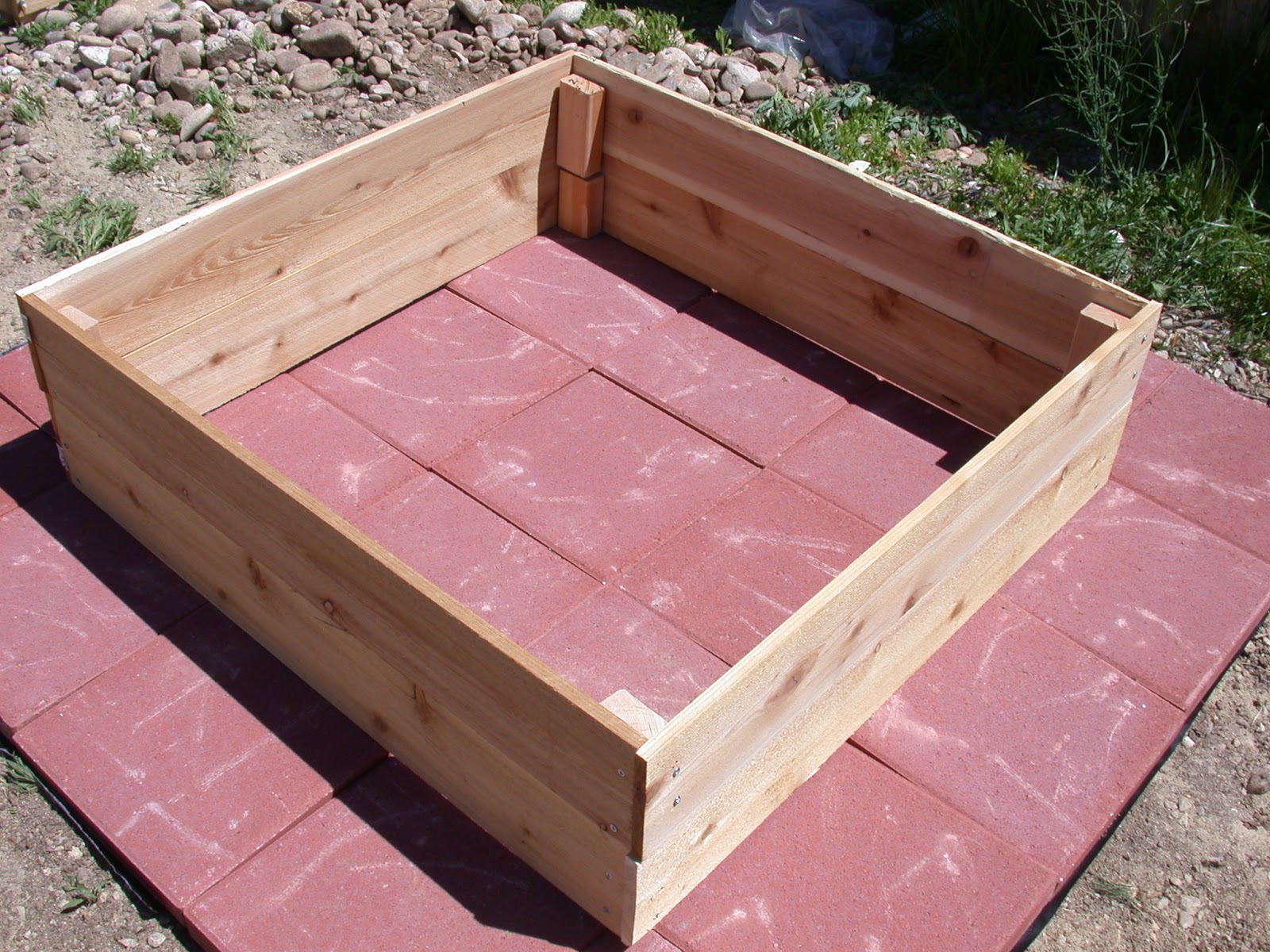
The bottom frame looks like this.  It sits flat on the ground.
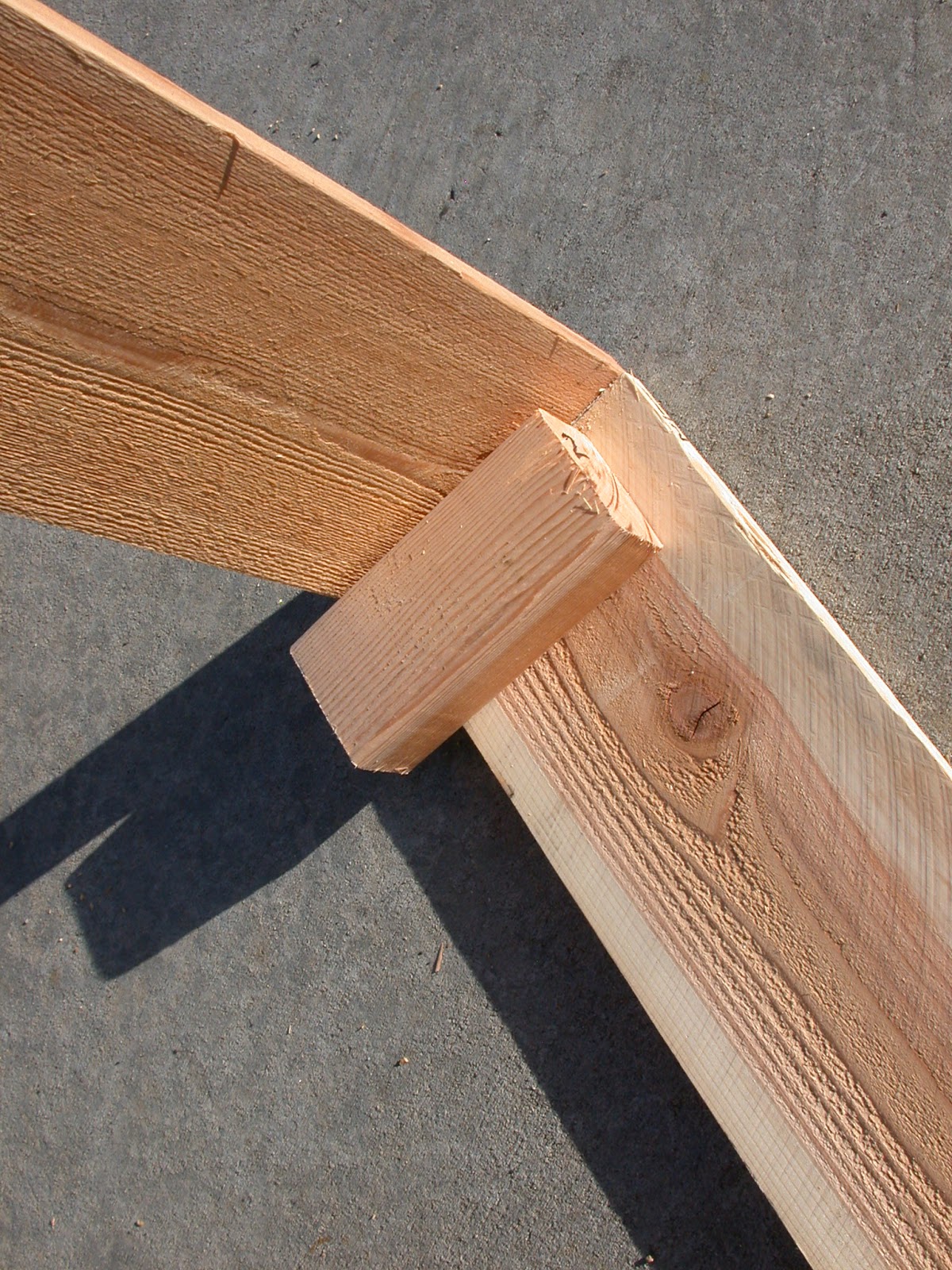
The corner supports are offset from the top edge so that
the second frame will fit snugly on top.


On the second frame, I fastened the corner supports so that
they would extend down into the first box.


I made sure that the two frames would fit on top of each other.

Like this.  


Then I made a third frame to go on top of the second one.  


And I made sure that it fit together well.


It fits!


Here is the finished potato planter box.  

You can see, in the picture below, that weeds grow pretty well in this rocky clay soil.  I did not want the excess water that I would use in growing the potatoes to encourage more weeds to sprout up through the potato planter box.  So, I first pulled all the weeds in that area.  Then I raked it smooth and laid down a layer of pavers with landscape fabric underneath.  
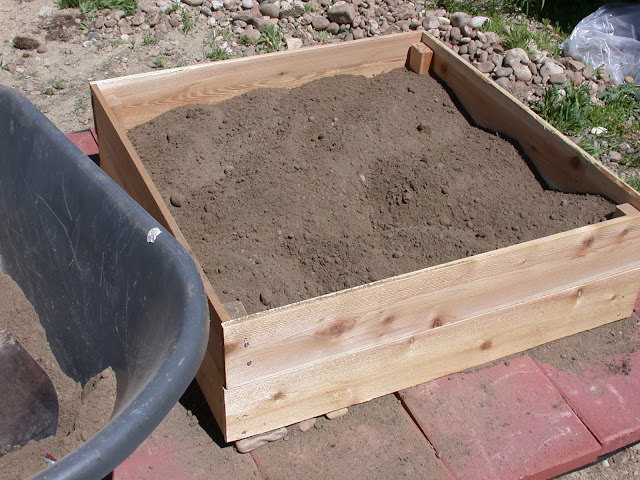
I put frame #1 and #2 in place on the pavers.

I put in some of the soil from that huge pile of soil that I had purchased.
You can see frame #3 in the background.  

I made a shallow trench and put the seed potatoes in the trench.

I covered the seed potatoes with soil.
  
I raked the soil smooth, and I watered it gently
until the soil was good and damp.


I watered the soil every day.
Two weeks later, the potatoes are coming up!


I am looking forward to freshly dug potatoes in the Fall!


Tuesday, June 2, 2015

Re-framing the Garden

Yes, it is June 1.  Warm weather has arrived and I am lagging behind on my gardening.  After much deliberation and much physical effort digging out and removing rocks, stones, boulders and building debris, I finally decided that it would take me years and years to dig garden beds and develop a good/deep soil profile.  Several friends had suggested that I simply build wooden frame raised garden beds like I had in Vermont.  Initially, I did not want to incur the expense of buying the lumber and then the soil.  However, I realized that I was already purchasing some garden soil, compost and peat moss by-the-bag and it was costing me quite a bit to do that.  So, I bit the bullet and bought some lumber, had a dumptruck deliver some garden soil, and began constructing my garden beds.

Six cubic yards of garden soil (70%) mixed with compost (30%).  

I had thought that I would make my garden beds 4'X8'X6".  When I went to Home Depot to purchase the lumber, I found that they were out of 4'x8' lumber.  As I stood there contemplating "Plan B" (I didn't have one), the nice young man who had told me they were out of 2"x6"x8" boards told me that he would substitute 2"x6"x10' lumber for the same price!  Not one to look a gift horse in the mouth, I immediately knew what my Plan B was, and decided that my garden beds would be 4'x10'.  

It seemed a simple matter, but as I looked over my yard I could see that the yard was actually a trapezoid and not a rectangle as I had thought.  The trapezoid shaped yard was creating a lot of puzzlement in my mind.  Everything seemed very uneven.  Those who know me will appreciate this "dilemma".  Should I run the beds parallel to the fence or to the patio???  What would I do with the little leftover triangle-shaped beds that would result from either plan?  I measured and graphed everything out on paper and sketched out several different plans, and finally decided on this one.


2015 garden plan - second iteration

I ran a string to indicate the line that would parallel the fence.  After sawing lumber and drilling pilot holes so that the boards would not split, I began to assemble my garden beds.  Then I placed them along the line and made sure that they were straight.  


Beds are aligned along the green string.  


Then, I lined the beds with corrugated cardboard (leftover boxes from my recent cross-country move).  Then I filled each bed with the soil.  You may recall that I already had broccoli, peas, radishes and tomatoes planted.  Of course the previously planted beds were off center and out of line with my new plan!  I took the row cover off and admired the broccoli, radishes and peas.  Beautiful plants.  


The row cover not only insulated the plants from freezing temperatures, 
but it kept the insect pests away! 


I could also see how far "off" the bed was....


I did not want to disturb the plants, if possible.  I only had to dig up a few of the broccoli plants, align the beds, fill the beds with soil and transplant the plants into the newly aligned beds..  
  
I know my rows are slightly angled, but this is a temporary situation as the broccoli, radishes and peas will soon be harvested.  Once I plant the next crop, I will have straight rows once again. 

I used this opportunity to thin the radishes!


A convenient benefit that I had not realized would happen, is that my row covers fit the ten-foot long bed.  The concrete reinforcing wire which I use as the framework of my row covers is five feet long.  So two row covers laid end to end, fit perfectly inside the ten-foot long bed. 


Row covers are back on.  They fit perfectly


This process took me about two weeks.  


Friday, May 1, 2015

Time to Plant Peas,Radishes and Broccoli Seedlings!

Time flies by when one is having fun.  It even flies by when one is not having so much fun!  I had a bad cold that lasted three weeks.  

Typical springtime weather means that today it may be 79 degrees Fahrenheit and tomorrow 38 degrees Fahrenheit.  We are definitely subject to possible freezing temperatures at night.  However, it is the perfect time to plant peas and other cool weather crops.  

I did not get any gardening done when I was sick. Finally, on April 20th, I saw that the month of April was slipping away and knew that I had to start getting peas and radishes planted!


Last fall I had cleaned out all the old plants, added compost and raked the bed smooth.  A hard crust had formed on the soil over the winter.  I used a rake to break up the crust and loosen the soil and rake it smooth again.  

In the background you can see I also set up six "Wall-O-Water" season extender tepees which I will use for tomato seedlings in a few weeks.  Right now, the Wall-O-Waters are like miniature greenhouses and are helping to warm up the soil.   


I planted a row of Sugar Sprint Snap Peas.  In the past, I have soaked the pea seeds overnight and then dusted them with legume inoculant before planting.   The legume inoculant has beneficial bacteria which encourages the legumes to form high-nitrogen nodules on their roots.  The nodules result in bigger plants and better yields.  This year, all the inoculant I found in the stores indicated that the seeds should not be soaked and that the inoculant should be sprinkled liberally in the row along with the seeds.  So that is what I did.  As an aside, sprinkling the inoculant liberally resulted in using the entire package of inoculant in that one row of peas!  

I planted a row of radishes right next to the row of peas.


I also planted some broccoli seedlings, making two rows of plants, spacing them 18" apart.


Our spring winds are cold and dry.  Seedlings can sometimes become desiccated and die.  I decided to utilize a row cover to help mitigate the temperatures and wind.  I created the row cover by stapling lightweight row cover fabric on a frame of concrete-reinforcing wire.  This is the same wire that I use to make tomato cages.  I poked  the wire ends into the ground to help hold the whole thing in place.  I felt that it was still too lightweight and could easily blow away in the wind, so I secured it all down with lengths of 2"x4" lumber and a cinder block at each end.  


Now I'm waiting for everything to sprout!

Sunday, April 5, 2015

Aaaaaaaand, They're Up!!

Here they come!    Five days after sowing the seeds in individual peat cells in my miniature plastic greenhouse, tomato seedlings are beginning to sprout!

Day Five: Tomato seedlings begin to push up through the soil surface!

Day Six: Most of the tomato seeds have sprouted!


Day Seven: The pepper seedlings begin emerging from the soil!

..... and also Day Seven: the tomato seedlings are looking good!  Visions of yummy tomatos sliced on a burger, diced in a salad and eaten whole right in the garden make me smile!


Wednesday, April 1, 2015

Starting Tomatoes Indoors

It has been the typical on again, off again Spring weather.  One day it is warm and sunny and the next day it is freezing!  It is so tempting to get the seeds planted.  Depending on what source a local gardener consults, the last killing frost of the year in this location happens (on average), on or around May 15th.  It is the words "average" and "on or around" that allows for freezes to happen later than May 15th.  Let's face it, we are talking about predicting the weather.  Not exactly an exact science.  An old saying dictates that there is nothing more changeable than the weather.  However, I once read a newspaper article written by Margaret Lauterbach, a local Master Gardener, in which she said that peas could be planted shortly after St Patricks Day.  

It was raining on St Patricks Day so I couldn't get out and plant in muddy conditions.  I opted to start my tomato seedlings!  

This year, I chose to buy a seed starting flat.  The flat included a bottom tray to facilitate watering, tiny cells made out of  peat, and a "greenhouse" cover.  I also bought some seed starter mix from the local garden center.     

Here's the seed starting flat:  the bottom tray with the little peat cells resting inside, and the greenhouse cover.


I poured in the seed starting mix, and smoothed it into the peat cells with my hand.  


I made labels by cutting strips from an old plastic milk jug and used a waterproof pen to write the name of the variety and the date planted.


I planted three tiny seeds in each cell, and covered them lightly with the seed starting mix.


Three tomato seeds in their cell, waiting to be covered with soil.


As I planted each row, I labeled it with the label that I had made.

Then I poured water into the bottom of the tray, to a depth of about 1 inch.  The soil quickly soaked up the water, wicking it upward into the top layer of the soil.  


Then I put the greenhouse cover on top and set it on my warm seed starting mat.  

I have always used a household heating pad, the kind purchased at a drug store, to provide extra warmth for my seedlings.  It has worked fine for me in the past, but this year I splurged, and bought myself one of the electric seedling heat mats.


 Now all I have to do is wait for the seeds to germinate and come up out of the soil!


Friday, February 6, 2015

A Few Warm Days Trigger Gardening Urge

Nothing like a few warm and sunny days for triggering a gardening urge.  However, it is only the first of February.  That means it is still winter.  It will probably be another month and a half until I can even plant peas! However, now is a good time to think about the vegetables I want to plant this year.

I was shopping this week and noticed that all the home improvement stores, hardware stores and grocery stores are putting out racks of garden seeds.  I was drawn to them like a moth to a flame!  A person can spend a lot of time standing in front of those seeds, trying to decide what to grow. 


Sometimes I find it difficult to find the exact kind of tomato or green bean seed in the seed rack.  It doesn't appear as if the seed rack contains a variety I had heard about from a friend, or from a program on TV or the internet.  For this reason, I have found that I like perusing the seed catalogs, either online or in hard copy, in the comfort of my own home.  All the information that one can find on the front and back of each seed packet is written in the seed catalog.


Every seed company is different.  Some offer all organic seeds, others offer all the new hybrid seeds, or lots of heirloom varieties or varieties developed in foreign countries.  I generally explore five or six different seed catalogs or seed company websites.  The old style (paper and ink) seed catalog, which is mailed to a physical address, is still a favorite way of shopping for seeds.  It's easy to jot notes in the margins of the pages so that I can return to the page later. 

Most, if not all, seed companies also have online catalogs now.  It is very easy and convenient to order seeds online.  Their seeds are competitively priced. Many seed companies author online newsletters or blogs, and offer coupons and discount codes once you are subscribed.  

Of course, I want to grow everything!  I make a wish list of all the different varieties I want to grow.  Then, I have to look at my garden diagram and figure out exactly how many plants will fit.  Finally, I have to go through the list and winnow it down to the ones I will actually have room for!  

For my garden diagram, I have used the online garden planner available through a link on Territorial Seed Company's website.   The garden planner has video tutorials that helped me understand all the features.  I used the draw feature to show the basic dimensions of my garden beds, and then used the click and drop feature to "plant" my garden.  The garden planner is very cool, in that it told me that the garden space I have allowed for peppers has enough space for 14 Ancho pepper plants, three tomatillo plants, five tomato plants, 73 radish plants, etc., etc.  It is a useful tool.  It is also a fun way to plan a garden.  The garden planner is free for 30 days.  

The last step was to order the seeds.  I did that online.  Mission accomplished.  I am looking forward to planting!


Sunday, January 11, 2015

It Is Not Too Late to Plan...

Up until now, I had been proceeding with an informal plan "in my head".   I decided that I  would like to make a basic, Beginning Yard Map of my backyard so that I could plan with a little bit of forethought.    I measured the perimeter and graphed it out.  This is what my back yard looks like without the garden beds that I created. 

It isn't totally accurate, but it is close.  Each square = 3 square ft.  

Beginning Yard Map


I also wondered about what sort of utilities might be buried under the surface of my yard.  I did not want to accidentally damage some utilities while digging.  I should have done this before I ever began to dig, but as soon as I thought of it I decided I better get it done before I got too involved in my plan!  

So I called the Dig-Line.  It is a free service.  They came out within a day or two and located buried electricity, natural gas, telephone and cable tv lines, marking them with colored spray paint.  It turns out that the only buried lines that are in the backyard are telephone and cable tv.  

I was relieved to learn that I hadn't dug close to those lines!

I  transcribed the utility line locations onto my diagram.  They are the purple and orange dashed lines.  Then I drew in the garden beds that I had created in 2014 (indicated with a blue arrow).  

Phase One - Year One Garden

I am calling this my Phase One -Year One Garden because I am just planning and putting in the beds, or planting areas.  I have lots of ideas to expand in the coming years!